In early 2006 a new batch 10 of Th lamps was bought for HARPS.
The producer of the old lamps, Cathodeon, was bought by the company
Heraeus, from which we bought the ten lamps, model # 3UAX Th,
the same model # that used Cathodeon. We were expecting the new
lamps to be of the same quality as the old ones, but this came out
not to be the case. The new batch of lamps features a higher background,
pronounced "bands" of unknown materials which are also responsible for
the variation of the profile of the Th lines. These problems are mostly
noticed in the red part of the spectrum. Most disturbinlgy these
features
are reported to vary with time, to a level larger than 1m/s.
Below the Heraeus lamps are compared with the Cathodeon lamp.
In all the exposures the Cathodeon lamp is operated at 9mA.
The Heraeus lamps are operated at 10mA unless otherwise stated.
In all cases we examine the order # 92 close to blaze maximum.
The strong line to the center is the Argon line at 666nm. The fluxes
are all normalized to 1 at this wavelength.
The three strong lines visible in the plots are: Th (665.867), Ar
(666.068nm), Th (666.227). Logfile of the tests. e-mail exchange with HERAEUS e-mail exchange with ORIEL
The 10 lamps
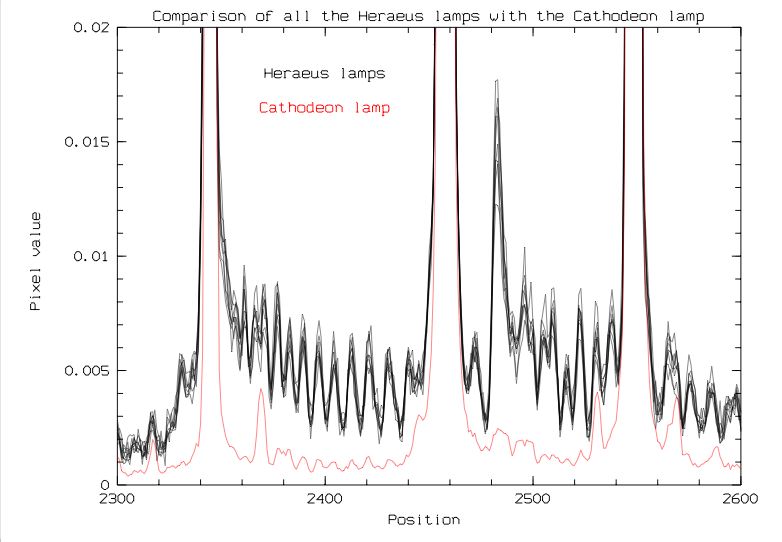
In the figure below is clearly visible the disturbing behaviour of the
new lamps.
The black lines represent the spectra of all the Heraeus lamps.
The background between the strong Th and Ar lines is much higher than
for the Cathodeon lamp, by a factor about 5 to 10, moreover the profile
of the lines (especially Th 665.867, to the left) is modified.
All the new lamps behave in the same way.
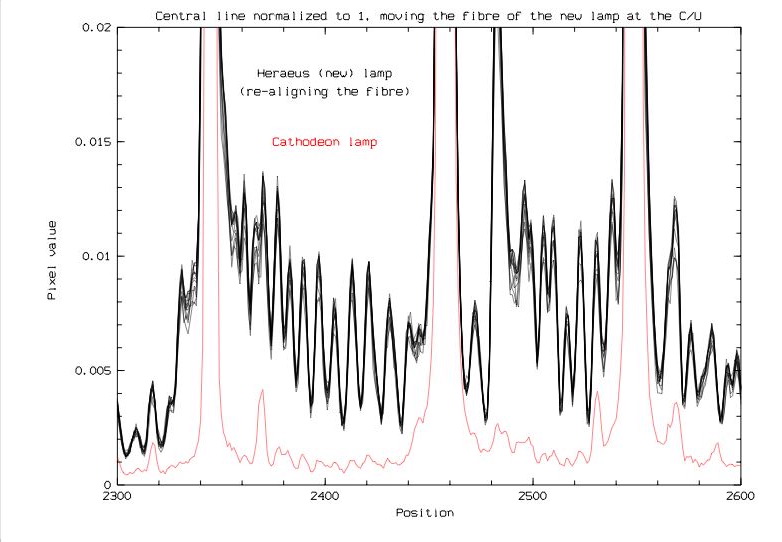
Effect of fibre alignement
The effect of fibre alignement is tested by moving the carriage holding
the calibration fibre at the calibration unit to different positions.
The flux, as a function of fibre position, describes a gaussian-like
curve.
Both the peak and the two wings of the light distribution were studied,
with the wings having flux lower by a factor two or more
than the peak.
The misbehaviour of the Heraeus lamps is not due to the alignement of
the fibre in front of the Th lamp.
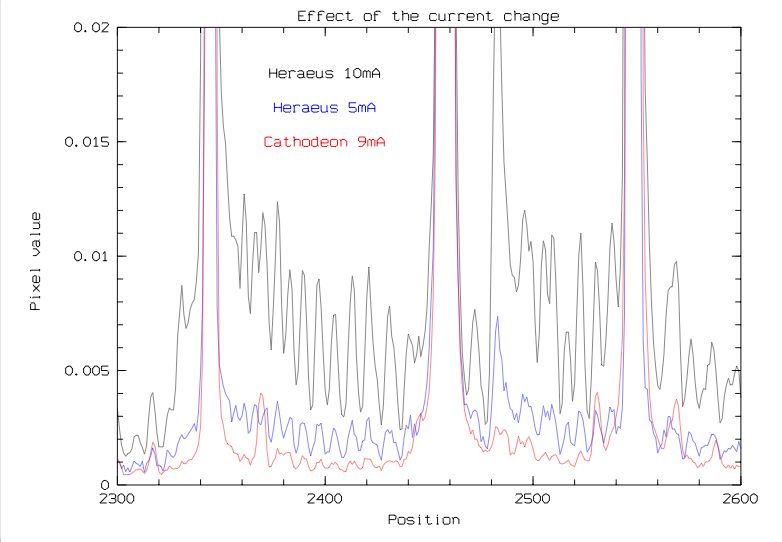
Effect of the lamp current
The current has a very strong effect on the behaviour of the new lamps.
If the Heraeus lamp is powered by a current of 5mA the background is
considerably lower. It has to be verified whether the new lamps
can be
effectively used with very low current.
Testing other lamps
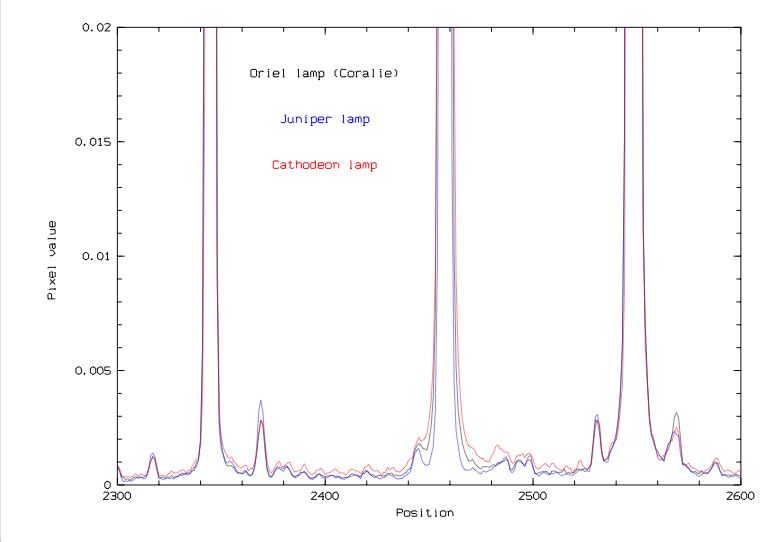
The spare Coralie lamp, produced by Oriel, the spare FEROS lamps
produced by Juniper and the new EMMI echelle lamps were tested.
Unfortunately only ThArNe FEROS lamps are available as spares in La
Silla at present. The test with the
FEROS ThArNe lamp showed that this lamp is not comparable to any of the
HARPS lamps.
Both the Coralie (Oriel) and the EMMI (Juniper) lamps behave like the old
HARPS Cathodeon. After inspection of the Oriel web site it became clear that
today they get their lamps supply from Cathodeon/Heraeus, and therefore we
expect their lamps to show the same problem as the Heraeus lamps we have.
We are left with the Juniper option. The Juniper lamps are larger than
the Cathodeon/Heraeus and will not fit in the HARPS calibration unit support.
Nevertheless Juniper seems the only viable option.
Conclusions
- The HARPS Th lamps from the new batch supplied by Heraeus are not
suitable to use with HARPS when powered with a current of 10mA.
- The spectra of all these lamps look alike.
- Their behaviour is not affected by the alignement of the fibre in
front of the cathod.
- Their behaviour is strongly affected by the operation current. When
operated at 5mA the Heraeus lamp behaves similarly to the Cathodeon
lamp.
- Another producer has been identified (Juniper) that was able to produce
lamps with the characteristics needed by HARPS.
Proposal for action
1) Investigate whether the company Juniper still produces the Th lamps of
the quality we need.
2) If this is the case buy two Th lamps (possibly of the right
dimension to fit in the HARPS calibration unit) and test them.