EUROPEAN SOUTHERN OBSERVATORY

|
|
EUROPEAN SOUTHERN OBSERVATORY
La Silla - Science Operation Department |
FEROS maintenance plan :: procedures |
| Version: 1.0 2002-11-06 Ivo Saviane |
FEROS shutter: mechanical release might degrade with time due to increased
friction. Shutter could not be light tight. It could not open completely:
 Test shutter delay time with proper images
Take DARK with dome lights on, see if light spills in
Use beta light to see if vignetting due to not complete open
The alignment can be directly checked inside the instrument using the autocollimator telescope.


|
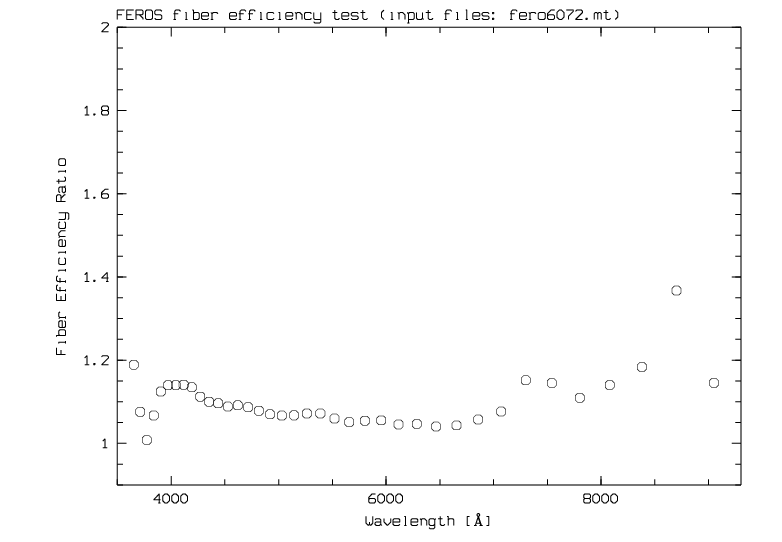
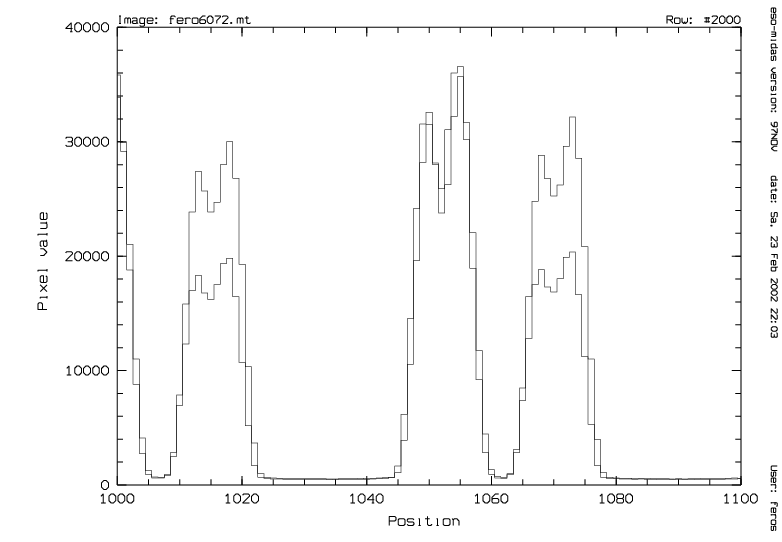
take sky flat (with dome slit slightly opened) - clean dust - take another sky flat
 , a possible explanation is that the
 beam is not centered on M2. To check this:
A second possible explanation for a reduced transmission of the fibers can be dust in/on the entrance apertures of the fiber head. These 0.3mm holes point always upwards an are therefore fully exposed to dust falling into the telescope's cassegrain tower. It is probably difficult to inspect the fiber apertures for dust with the fiberhead mounted in the instrument. If alignment with M2 should be needed, the opportunity should be taken to take out the fiber head and to check the apertures.
A compromise has been reached, such that one of the fibers has the best alignment with M2, and has been labelled ``object''
|
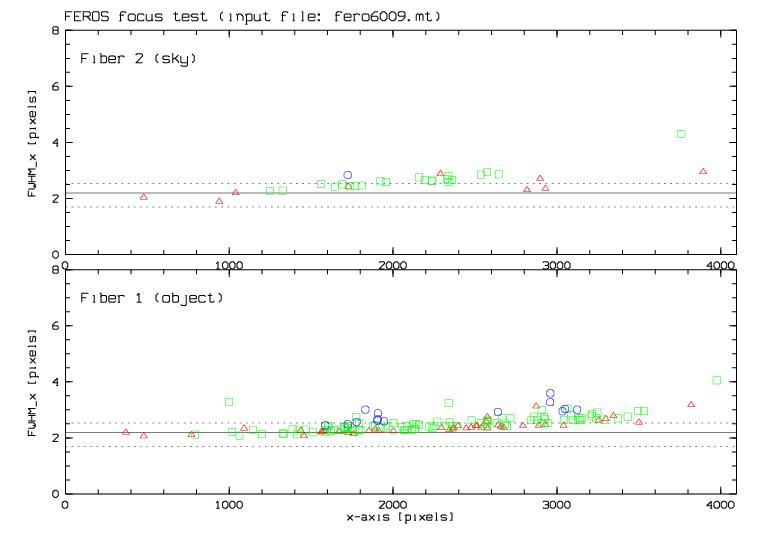
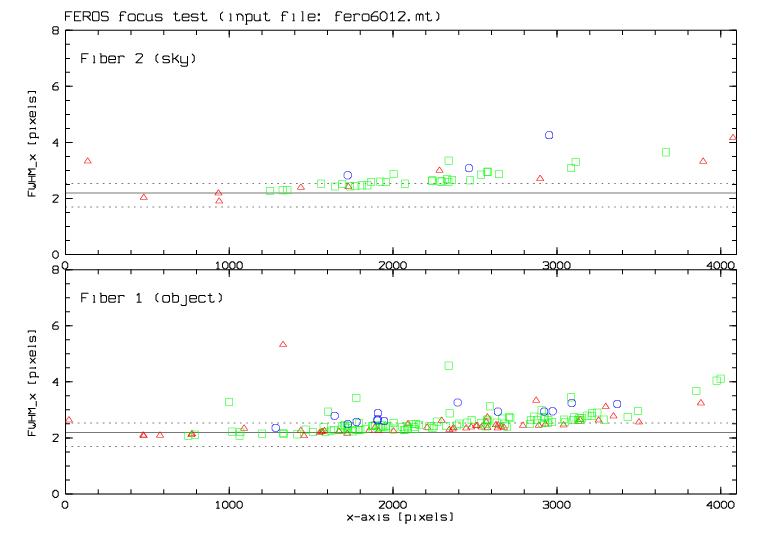
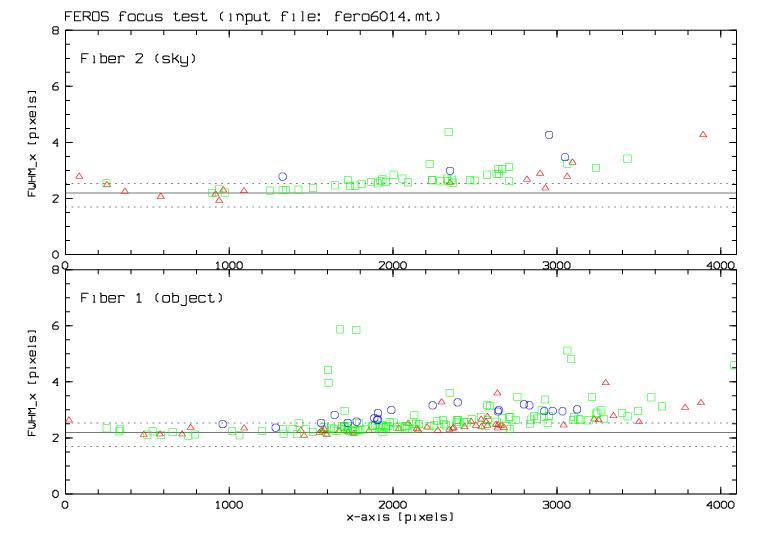
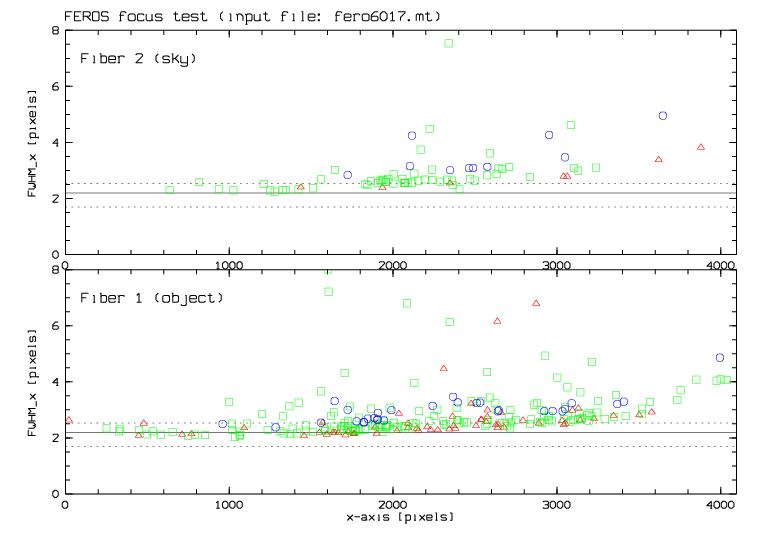
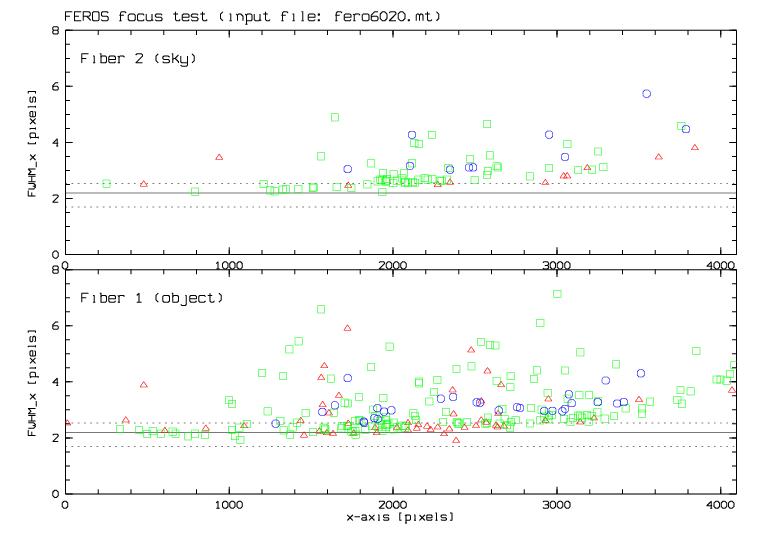
 Focus can be monitored with @@ focus. With a procedure TBD, the
plots and resulting numbers will be recorded and trended, especially as function
of room temperature.
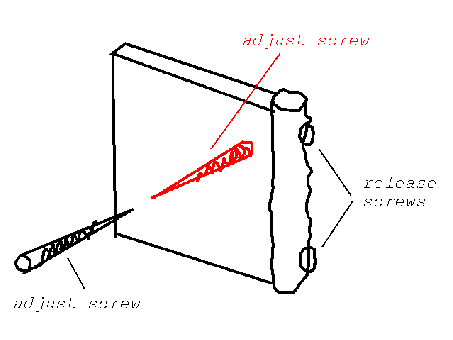
Fine-tuning of focus can be done by changing camera focus with micrometer
screw
If the temperature change is larger than 5C, and the original T cannot be restored, then the camera focus might need adjustment, since the passive thermal focus compensation in the camera has a limited precision. The camera focus is very sensitive and needs a 20micron/K compensation. Most of this compensation should be covered by the passive temperature compensation (a plastic rod inside the camera focus mechanism).
The flat-field lamps should also be monitored in intensities and spectral distribution. This probably requires the pipeline to do it properly. But simple checks and recording of 'cuts' through some standard exposure time flats should do. If spectral intensity distribution changes this could be due to changes of the lamp currents on the power supplies, or due to the alignment of the red and blue flat-field lamps + filters inside the calibration unit, or really due to aging of the lamps.
The FF lamps must run at constant I. So check STATRON
power supplies in computer room. Light must be on on CC led.
At the time of inspection, values are 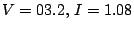 for the red lamp (halogen 1), and
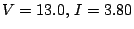 for the blue lamp (halogen 2) (values in Volt and milliAmpere).
It is possible that a lamp was on the I limit but suddenly changes to the V limit if its resistance decreases as it is the case for an aging lamp. The halogen lamp 1 should also be adjusted to run with 12V max. A balancing of the overall spectral distribution in the flatfields shoul be tried by adjusting the currents of lamp 1 and 2.
If the CCD camera is dismounted, there is a mechanical piece inside FEROS to align the camera with the optical group. The piece should be interfaced between the two, then optics moved back, piece removed and optics moved into original position.
Control PCs (CCD and calibration unit): standard maintenance like fans; lifetime of disks is of the order of 3-5 years. Could be exchanged before they fail.
The BIAS PC and ins1p5 WS must have UT synchronized by crontab entry (e.g. ntp).
The UT time recorded in the fits header is the time on the BIAS PC.
It should be checked that
cleaning of the fiber connector surfaces on the calibration unit: the fiber which can be plugged between the two positions (OS - OC) must be checked for clean entrance surface. The same for the counterpart mounted inside the calibration unit. Dust on the fiber should be recognized as reduced throughput on the sky fiber
the mirror of the fiber head might need some cleaning from time to time. Blowing off the dust should be sufficient. The mirror is polished aluminum, therefore should not degrade in efficiency with time.
Movable parts in the calibration unit: the alignment of the 4 mirror positions (S1-4) is critical. Misalignment should be noticed through uneven illumination of the two fibers by the calibration lamps.
Blow off dust from mirrors.
Check pressure in the legs, shake the table to see that it freely floats. There is a gauge inside FEROS to tell if the table is horizontal. Use pump that is in cabinet outside the room. The proper pressure is marked on the display.
For the prism crossdisperser AK suggests to monitor the position of the orders on the CCD in crossdispersion direction, with a procedure TBD. The pipeline applies a crosscorrelation when searching for the orders. The zeropoints of the dispersion solution per order will be recorded. Same for the echelle in dispersion direction. When creating the wavelength solution, the pipeline first x-correlates with the guess session. A reference guess session will be defined, so shifts in dispersion (and cross-dispersion) direction will be monitored.
(AK) The @@ init procedure is doing a monitioring of the shifts between object and sky fiber (that was not delivered with the instrument) but this is the way to do it. The routine just logs the result in a (hidden) file.
See URL:
/sci/facilities/lasilla/sciops/2p2/E1p5M/FEROS/FEROS_CP/FEROS_CP.ps
Moreover, these notes are added to the SCP document.
airmass.prg exti.prg plotall.prg res.prg
autoreduce.prg fiberratio.prg plot.prg shifts.prg
average_cat.prg fitimaqual.prg plot_res.prg showtime.prg
bcgt15.prg focus.prg prered.prg sizetab.prg
bdf_mt.prg iden.prg radvel.prg snr.prg
ccdrongain.prg init.prg reduce_cat.prg temperature.prg
colmean.prg listferos.prg reduce_FF.prg xcorall.prg
create_cats.prg loadccd.prg reduce.prg
do_cat.prg login.prg reducestd.prg
efficiency.prg over.prg reduce_ThAr.prg
I suggest to create new dirs for each new CP, with the month/year, and recreate the original dir structure there
You can mkdir, and then use
/data1/feros/cal_db/crea_tree.sh
a) dirs with name of month+year contain past calibration plans' data
972386 ./May-Nov1999
416 ./Aug2000
1543090 ./Jun-Dec1999
b) this contains data that were in cal_db, which should be empty according to pfrancois' calibration plan
323973 ./ex-top
c) this contains (I guess) the first calibration plan's data
918682 ./Jan1999/FEROS
d) I moved here things that I don't know
79033 ./shall_we_delete
e) I left the prg's in the original directory
194 ./FEROS/MIDAS_proc
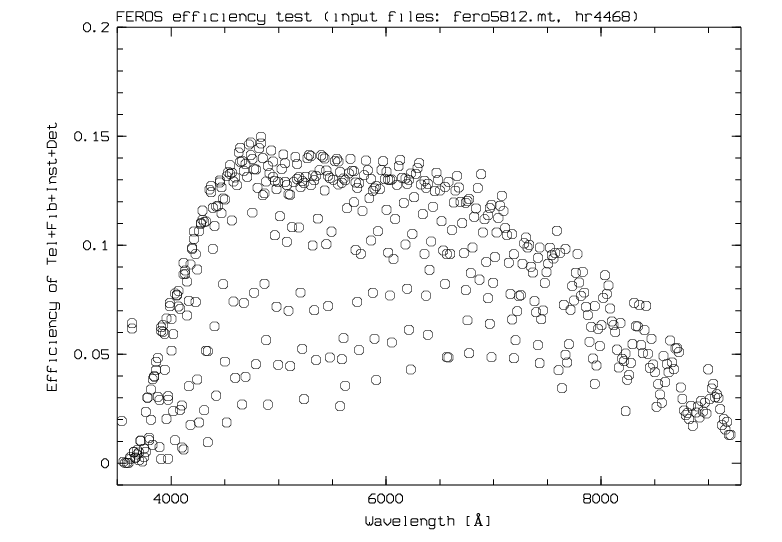
The efficiency measurement depens critically on the seeing and guiding.
A maximum efficiency of  was observed for HR 4468 of February 18 (see Fig. 4). Previously, maximum efficiencies
around
 have been observed. Efficiency should be monitored constantly in order to
find the maximum obtainable in the best conditions.
Note that flux tables are available in MIDAS for just a subset of commonly used spectrophotometric standars, which should be observed if one wants to use @@ efficiency. The tables are stored in
/home/scisoft/midas/calib/data/spec/ctio/
and the standards at the moment are:
cd32 eg21 eg274 f110 f56 h600 hr1544 hr3454 hr4468 hr4963
hr5501 hr718 hr7596 hr 7950 hr8634 hr9087 l1020 l1788 l2415 l3218
l377 l3864 l4364 l4816 l6248 l7379 l745 l7987 l9239 l9491
The responsible for purchases in Garching is, in Feb 2002:
Alberth, Manuela: ext. 6391 (malberth@eso.org)
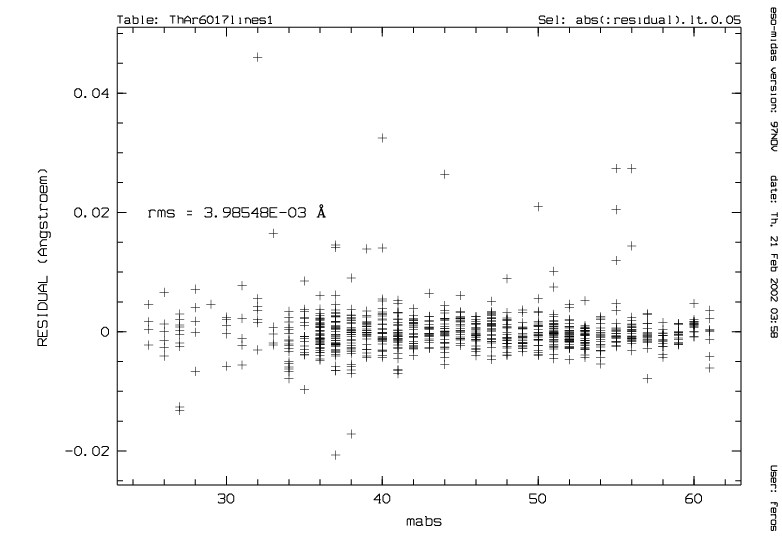
High purity Thorium must be specified in the purchase order.
 and
 (Feb 2002). Click on the images for a full resolution graph