
|
EUROPEAN SOUTHERN OBSERVATORY

La Silla - Science Operation Department
|
HARPS TEMPERATURE RISE 05/07/2004
|
| Version: 2.0 2004-09-06 Gaspare Lo Curto
|
Analysis of the temperature rise event of 05/07/2004
This pages describes the events related to the temperature rise
of HARPS on 05/07/2004.
The event
On July 05, 2004 the temperature of some of the spectrograph most
critical
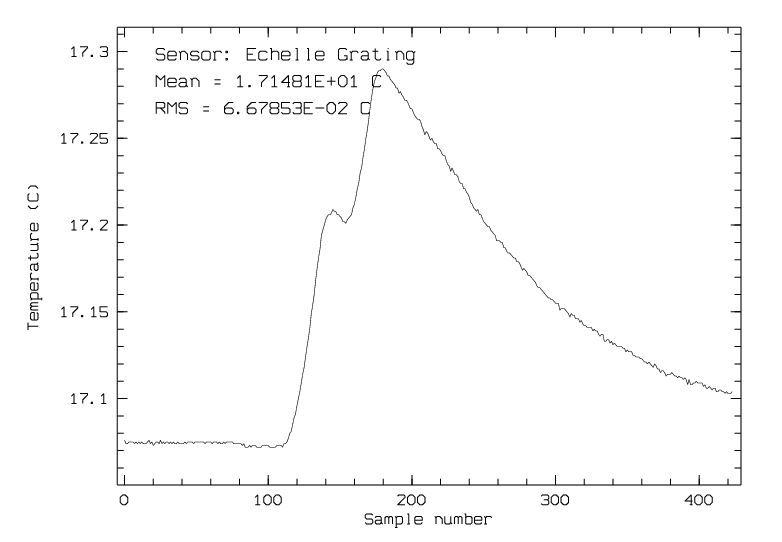
components increased by up to 0.2 degrees Celsius at the grating.
This had a enormous effect on the instrument profile, generating a
drift of up to 5m/s in one night. For reference, the drift over one night,
in stable conditions, is generally within 0.5m/s.
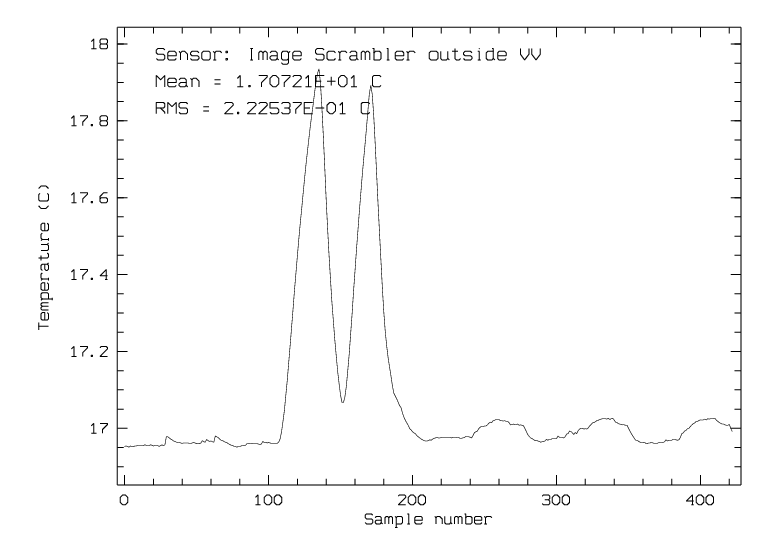
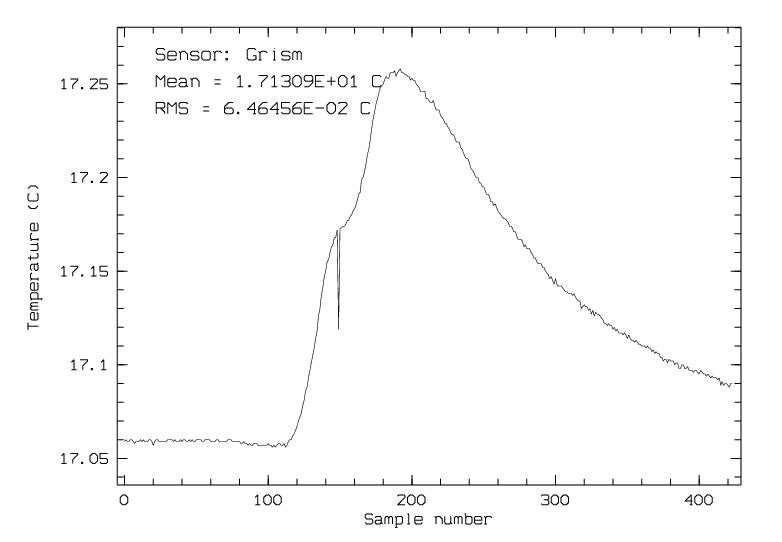
Below are the time plots of several relevant temperatures.
In the plots sampling started on July 3rd at 12:00 UT and ended on
July 9th at 12:00 UT. We take one sample every 20 minutes.
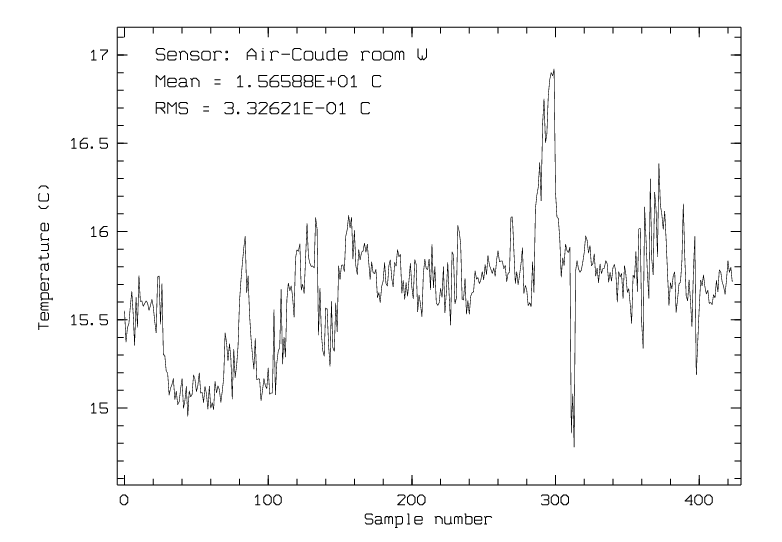
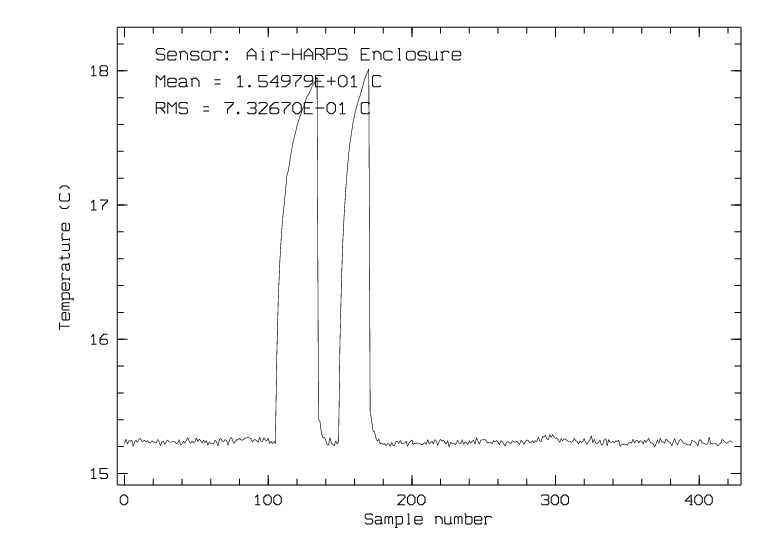
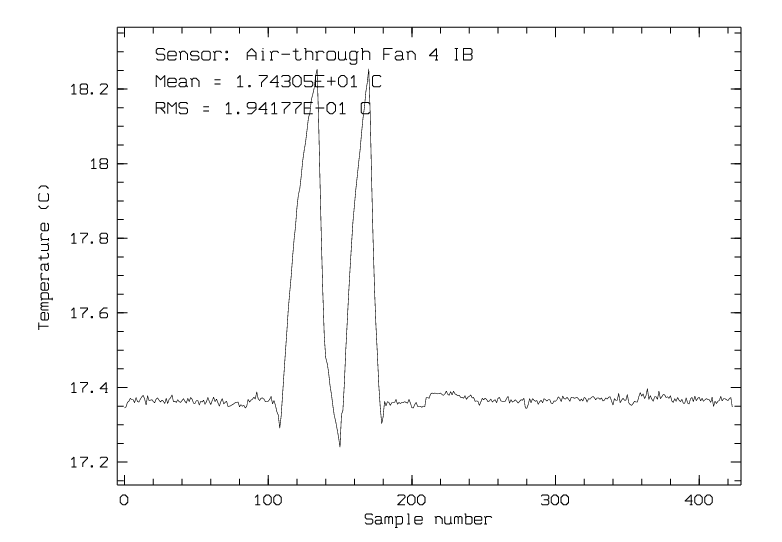
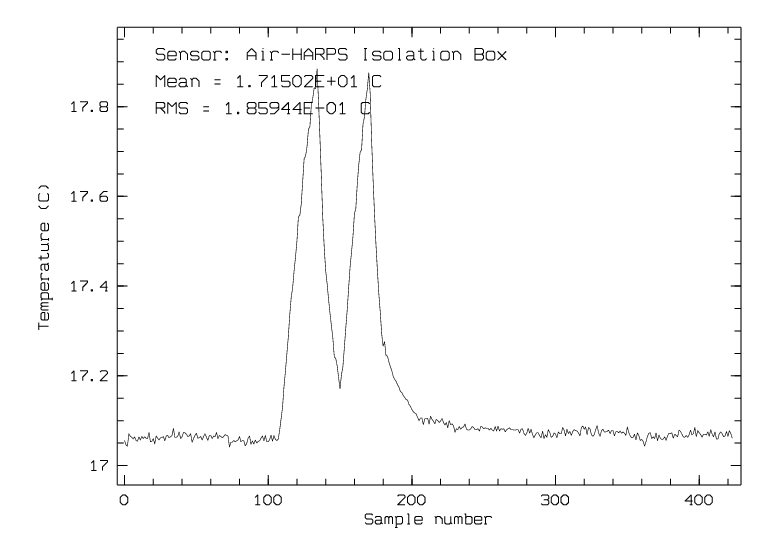
Playing with numbers we can say that to a variation of 2.8C of the
temperature of the HARPS enclosure corresponds a variation of 0.28C
(a factor 10 less !) of the temperature of the grating.
The RV drift introduced is roughly of 1m/s per 7mK variation of the
grating, or 1m/s per 70mK variation of the HARPS enclosure temperature.
The cause
From the plots above it looks like the origin of the problem was the
stopping of the HARPS enclosure air conditioning. This might be due to a
power cut, althought it was not reported to have happened in other
instances of power cuts.
There were 4 power cuts between Friday 3rd and Monday 5th:
| START (CLT) | DURATION |
| July 3 16:25 | 6 minutes |
| July 4 21:25 | 8 minutes |
| July 5 12:15 | 6 minutes |
| July 5 15:15 | < 1 second |
| | |
The first power cut on July 3rd did not affect HARPS, while the second
seems to be responsible for the switching off of the HARPS enclosure air
conditioning. The air conditioning restarted by itself after about ten
hours with no apparent reason. It then stopped again at the time of the
third power cut at 12:15 CLT on July 5th to restart after about 7 hours
again for not apparent reason. The fourth cut did not have any influence
on the system.
The temperature which reached the highest point is the one of the
"Air-through fan 4IB". This seems to point to the fact that the
heath source was within the IB: either the power developped by the
fans (100W) or the IB heater (100W).
The alarms were overlooked because there was already one known alarm going
off due to the disconnected HCFA iodine cell, and this lowered the level
of attention to the alarm window.
On July 21th La Silla suffered another power cut during a snow storm.
Also on this instance the air conditioning "stopped". After inspection
it appeared that the problem was that the pump circulating the cold water
stopped. It is a Salmson, plugged to 380V and using 116W of power.
According to specifications of the control system the pump should re-start
automatically for power cuts of up to 1 minute. For longer power cuts it
might not restart.
There are two pumps, and they run alternatively. Althought we still have
to know the time interval during which a pump is running this should be of
several hours. If we assume the air conditioning started again when the
second pump was started we would get a twelve hours period of continuus
operation per each pump.
Air conditioning control system analysis
After the events described it became clear that a throughful
analysis of the control system should have beeen carried out in
order to eliminate possible deficiencies and to make the system more
robust.
On August 25th and 26th Mr. Clemente Chappuzeau, the engineer
responsible for the system installation, revised the full system.
The control system before 25-08-2004
The two air conditioning cooling pumps were working alternatively,
for 3.5 days each. Let us call the two pumps A and B.
The system reset was programmed every 12 hours.
The system reset was supposed to give the system a fresh start in case
an error condition was encountered (pumps off).
In case of a power cut the pump (say pump A) could restart operation if
the power cut is shorter than 1 minute. Otherwise the control system would
switch to pump B. If after one more minute the pump would not yet be
working properly the control system would switch off both pumps, and
they will be left in this state until the reset occours.
This behaviour is perfectly compatible with the temperature variation
observed in the system. The reason driving this control strategy is that
in case one pump fails the other should start rapidly (1 minute). In case
both pumps fail, given that the system would not know whether this is for
a power cut or an intrinsic problem to the pumps, they both stop.
The control system after 25-08-2004
A relay (RPDF150) was inserted, having the function to detect a power cut
and to give the system a fresh start as soon as the power is back
(the same pump which was running at the moment of the power cut would be
energized again).
The reset time was reduced from 12 hours to 1 hour. In this case if the
relay fails the system would recover much faster.
The time to switch from one pump to the other in case of malfunctioning
was increased from 1 minute to 2.5 minutes. While this still obeys to
basic safety criteria, it allows a power cut shorter than 2.5 x 2 = 5
minutes to be recovered without having to rely on the relay.
Other actions
- Fix alarm thresholds - done.
- Locate alarm panel appropriately - done.
- Display permanently Air-HARPS enclosure (sensor 31) and Air-through fan
4 IB (sensor 33) in the HARPS telemetry panel - pending.
- Discuss the opportunity of the temperature alarm system calling a beeper
in case of temperature rise of the HARPS enclosure - pending.
- Improve the control program of the pumps - done.