Biases and Darks
Bias and dark current frames are taken with the same template - set the exposure time to 0 second for biases and any non-zero exposure for darks.
- See CCD #40 Bias Monitoring for bias values measured during CCD tests.
- Dark Current is about 6 ADU per hour per pixel (unbinned).
- The incidence of cosmic rays is about 900 events per hour over the whole CCD (measured from a Dark frame). Each hit typically covers an area of about 5 unbinned pixels in radius.
Biases frames are needed for every combination of Binning and Readout Speed used during observations.
The first few bias frames after a long pause (the CCD idle for an hour or two) show a "hot" column. This vanishes subsequently and does not affect later observations in any manner. One also sees this hot column if for some reason the CCD gets saturated in a big way (during twilight flats for example).
CCD #40's bias overscan region is inadequate. The overscan strip from row y=2049 to 2060 gives a level which is higher than the actual bias, is known to vary by up to 10 ADUs during a night (more typically by 3-5 ADUs); Programmes which need a more accurate determination of the bias should incorporate regular bias measurements during the night.
Make sure that the dome is dark when biases and dark current frames are being taken - there is a low level of light leakage into the instrument which however is not an issue during the night.
The best time to take dark current frames is at the end of the night after the telescope has been parked, the dome closed, and all lights have been switched off. One can leave the OB running. However make sure that the exposure sequence will terminate before 8.00 AM (local time) as the telescope staff start working in the dome after that.
6. Typically one needs :
- Biases: 10 frames during the afternoon and 10 at the end of observations on each day (for each binning/speed combination). This is sufficient for most programmes. Observers with more stringent requirements may take another 5 frames at the start of observations and 1-2 frames regularly through the night.
- Darks: 3 exposures of 1800 seconds each during the entire run. However the value has been constant at about 6 ADU per hour per pixel (unbinned) and the error resulting from using this value is much (much) less than the CCD read-out noise.
The above example shows an OB comprising a sequence of:
- 7 Bias frames with normal readout and 2x2 binning followed by
- 5 Bias frames with fast readout and no binning and finally
- 3 Dark current frames of 1800 second exposure with normal readout and 2x2 binning.
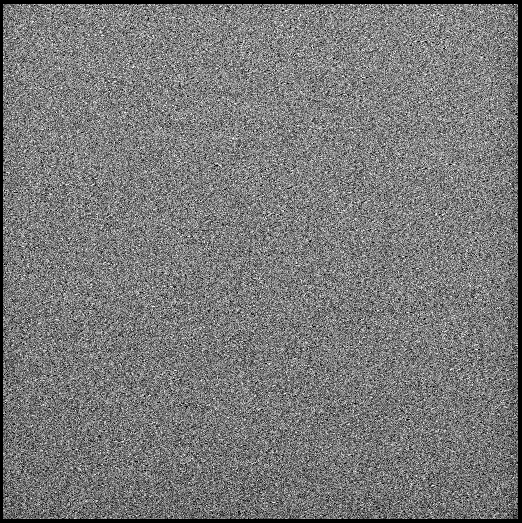
As an example the following image is given, which shows a Bias with
normal readout and 2x2 binning.
Click on the image to get a larger version:
Parameter Values One does not have to (in fact, should not) change the value of any parameter other than those of:
- Exposure time: 0 for bias; 900 - 2700 for darks
- CCD readout speed: normal, fast or slow.
- CCD binning : 1x1 or 2x2.
- Number of exposures: A template with 5 exposures is most useful. Those intending to take biases through the night may want another template with just 1 bias exposure.